The Role of Automation in Hiring, Marketing, and Business Expansion
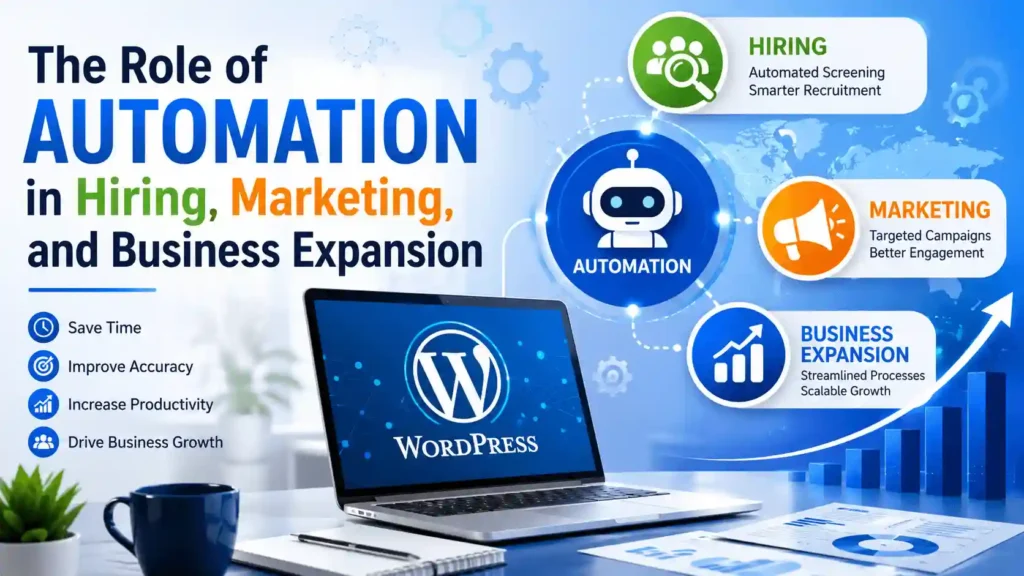
The Role of Automation in Hiring, Marketing, and Business Expansion
Nowadays, automation has shifted from being a supporting tool to becoming a core part of how modern businesses operate. Organizations today handle large volumes of data, customer interactions, recruitment pipelines, and marketing activities, all of which require speed, accuracy, and consistency.
Automation helps reduce manual effort in repetitive processes while improving decision-making through data-driven insights. From hiring new employees to running marketing campaigns and scaling operations, automation is reshaping how companies grow and compete in fast-changing markets.
What Is Business Automation?
Business automation refers to the use of technology to perform recurring tasks with minimal human intervention. These tasks can include data entry, candidate screening, email communication, reporting, customer segmentation, and workflow management.
Modern automation systems are often powered by artificial intelligence, machine learning, and advanced analytics. These technologies allow businesses to identify patterns, predict outcomes, and optimize processes in real time.
The primary goal of automation is not to replace human effort but to enhance productivity by eliminating repetitive and time-consuming tasks.
How Automation Is Transforming Hiring Processes
Recruitment has become one of the most significant areas impacted by automation. Traditionally, hiring involved manual resume screening, lengthy interview scheduling, and repetitive communication with candidates. This often slowed down the hiring cycle and increased workload for HR teams.
Today, automation streamlines these processes in several ways:
Smarter Candidate Sourcing
Automated systems can scan job boards, professional platforms, and internal databases to identify potential candidates who match specific skill requirements. This reduces the time spent searching for talent manually.
Efficient Resume Screening
Instead of reviewing each application individually, automated tools can filter candidates based on qualifications, experience, and role-specific criteria. This ensures only the most relevant profiles move forward in the hiring pipeline.
Structured Interview Processes
Interview coordination is often a time-consuming task. Automated scheduling tools simplify this by aligning candidate and interviewer availability without back-and-forth communication.
Many organizations now rely on ai interview software to bring consistency and structure into the evaluation process. It helps standardize assessments, reduce bias in initial screening stages, and improve overall hiring efficiency.
Improved Candidate Experience
Faster communication, timely updates, and smoother scheduling contribute to a better candidate experience, which is crucial in competitive job markets.
The Impact of Automation on Modern Marketing
Marketing has also evolved significantly with the integration of automation. Businesses now operate across multiple digital channels, including email, social media, search engines, and content platforms. Managing these manually can be complex and inefficient.
Automation helps marketing teams streamline operations while improving targeting and personalization.
Campaign Management and Optimization
Automated systems allow marketers to schedule campaigns in advance, track performance metrics in real time, and adjust strategies based on data insights. This reduces guesswork and improves campaign effectiveness.
Customer Segmentation and Personalization
Automation tools analyze user behavior, preferences, and engagement patterns to group audiences into meaningful segments. This enables more personalized communication that resonates better with potential customers.
Efficiency in Content Distribution
Consistent publishing across platforms is essential for brand visibility. Automation ensures that content is distributed at the right time and to the right audience without manual intervention.
A strong content marketing approach becomes even more impactful when supported by automation. It allows teams to focus more on creating valuable, high-quality content while systems handle scheduling, distribution, and performance tracking.
How Automation Supports Business Expansion
As businesses grow, complexity increases across operations, customer management, and workforce coordination. Automation plays a key role in helping organizations scale efficiently without significantly increasing overhead costs.
- Operational Efficiency : Automating repetitive tasks reduces manual workload and allows teams to focus on strategic initiatives. This improves overall productivity and ensures smoother day-to-day operations.
- Scalability Without Proportional Costs : One of the biggest advantages of automation is the ability to handle increased workloads without a proportional increase in resources. Businesses can expand operations while maintaining efficiency.
- Better Decision-Making : Automated systems collect and analyze large volumes of data, providing actionable insights that support strategic decision-making. This helps businesses identify opportunities for growth and optimization.
- Enhanced Customer Experience : Faster response times, consistent communication, and personalized interactions contribute to improved customer satisfaction. Automation ensures that customer expectations are met consistently across all touchpoints.
Challenges in Implementing Automation
While automation offers numerous advantages, its implementation comes with certain challenges that businesses must consider.
- Integration Complexity : Introducing automation into existing systems can be complex, especially for organizations with legacy infrastructure.
- Workforce Adaptation : Employees may require training to adapt to new tools and workflows. Change management is essential for successful adoption.
- Data Privacy and Security : As automation systems handle large volumes of sensitive data, ensuring security and compliance becomes critical.
Best Practices for Successful Automation
To maximize the benefits of automation, businesses should adopt a strategic approach:
- Start by identifying repetitive and time-consuming tasks
- Implement automation gradually rather than all at once
- Continuously monitor performance and optimize workflows
- Maintain a balance between automation and human oversight
- Invest in employee training to ensure smooth adoption
The Future of Automation in Business
The future of automation is closely tied to advancements in artificial intelligence and predictive analytics. Businesses will increasingly rely on intelligent systems that not only automate tasks but also make data-driven recommendations.
From smarter hiring processes to highly personalized marketing strategies, automation will continue to shape how organizations operate and compete. Companies that embrace these technologies early are more likely to achieve sustainable growth and long-term success.
Conclusion
Automation is no longer just a technological advantage—it has become a business necessity. By improving efficiency in hiring, enhancing marketing performance, and supporting scalable growth, automation enables organizations to operate more effectively in competitive environments.
As industries continue to evolve, businesses that integrate automation thoughtfully into their workflows will be better positioned to innovate, grow, and succeed in the digital era.