How Ground Conditions Affect Basement Piling Design
Basement Piling Design
Basement development can be the most complex form of residential construction, particularly in central London. Places like Chiswick are uniquely challenging due to the different soil profiles, groundwater issues and proximity with neighbouring houses. How Site Conditions Affect Basement Piling Design One of the biggest aspects to consider when aiming for a safe and successful build is how ground conditions affect basement piling design.
Home owners and developers planning a basement construction Chiswick need to have clear insight about the correlation between soil conditions and piling solutions. This is why an established piling companies London engage civil engineers from the outset of a project to ensure that suitable submerged marine engineering solutions are implemented.
Why Ground Conditions Matter in Basement Construction
Each basement project starts from below the earth’s surface, so your structure will be interfacing directly with soil, rock and groundwater. In contrast to above-ground construction, basements greatly depend on the in-situ soil/rock as support for load transfer and stability.
Ground conditions determine:
- The type of piling required
- Depth and intervals of piles
- Construction methods and sequencing
- Risks to neighbouring buildings
- Overall project cost and duration
And in the likes of Chiswick, where soil can differ greatly from one house to the next, it’s fair to say no two basements are ever alike.
Common Ground Conditions Found in London
In order to find the appropriate design of piles, A detailed ground investigation is generally performed before designing any pile. There’s a great variety of geology around London, but some common ground conditions frequently affect basement piling.
London Clay
The London Clay is one of the most prevalent local soil types in West london which extends into Chiswick. It is not fastened in place, It has a good load capcity but tends to shrink and swell according to its moisture content.
Implications for piling:
- The piles frequently have to penetrate below the depth influenced by seasonal movement.
- The potential for long term settlement needs to be avoided by careful design.
- Temporary support works are designed to account for clay stability during excavation
Made Ground
Many London properties sit on made ground, consisting of backfilled materials from previous developments.
Implications for piling:
- In addition made ground it is not trustworthy for structural bearing loads
- Piles must be driven through the made ground to reliable strata
- More testing is needed to determine any contaminant or obstruction
Sands and Gravels
Sands and gravels form river terrace deposits, especially alongside the Thames.
Implications for piling:
- These soils may be free-draining but loose when excavated.
- Groundwater control becomes critical
- Piling companies in London often use casing techniques to maintain stability
The Role of Ground Investigation Reports
An investigation of the ground is a cornerstone of safe design for basement piling. It typically includes:
- Boreholes and trial pits
- Soil sampling and laboratory testing
- Groundwater monitoring
- Historical site analysis
In basement construction, Chiswick, for example, the engineers use the knowledge of soil condition in that area to predict how it will hold up during excavation and incorporate that prediction with calculations on ground stress acting on the walls over time. Without it, the foundation engineers would be doing a best-guess design and incurring higher risk.
How Ground Conditions Influence Piling Type
Different soils require different pile solutions. Choose the wrong pile and structural settlement, wet weather issues or damage to neighbouring buildings can be the result.
Mini Piles
Since access is limited in domestic basements, mini piles enable foundations to be constructed where access would not otherwise be possible.
Best suited for:
- Confined urban sites
- Variable soil conditions
- Projects close to existing foundations
Mini piles for basements in Chiswick are commonly used by piling companies, such as London Basements, to hide space s With external access and little neighbourly impact with close surroundings, basements are popular with built up areas such as the affluent Chiswick area of London.
Secant Pile Walls
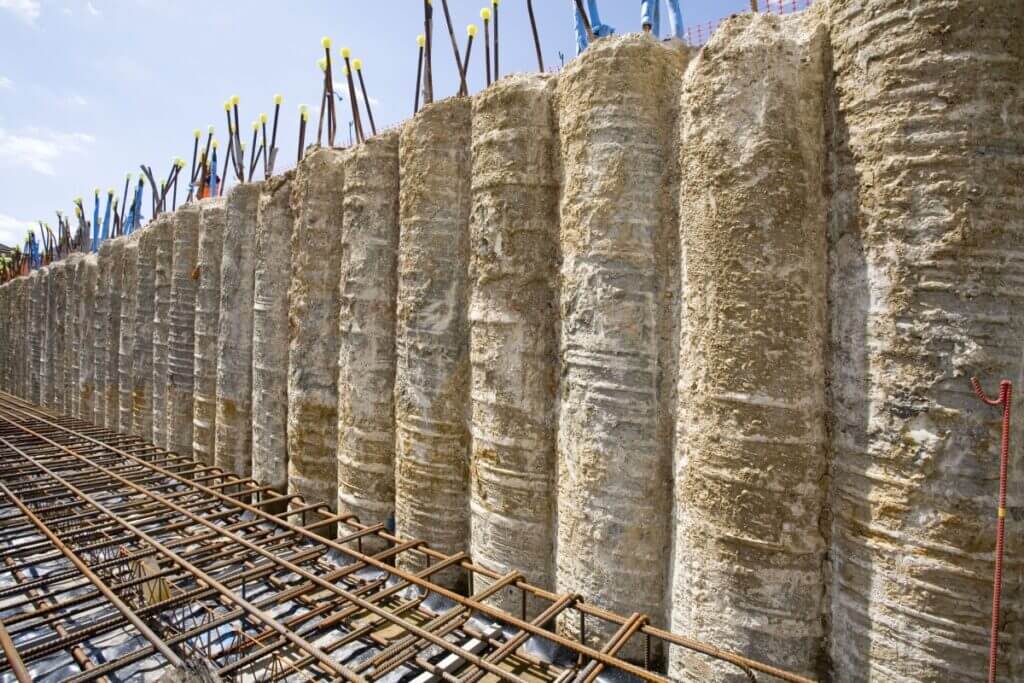
Secant pile is made by Constructing overlapping concrete piles, to make continuous wall.
Best suited for:
- High water tables
- Deep basements
- Sites requiring both earth retention and waterproofing
Ground conditions with significant groundwater influence often make secant piling the preferred option.
Contiguous Piles
Adjacent piling employs piles driven in close proximity, but not overlapped.
Best suited for:
- Stable clay soils
- Temporary excavation support
- Projects where waterproofing is handled separately
Groundwater and Its Impact on Piling Design
Groundwater is one of the most critical considerations in basement construction. High water tables are common in parts of London and can significantly affect piling design.
Key considerations include:
- Uplift pressure on the basement slab
- Risk of water ingress during excavation
- Long-term waterproofing strategy
For basement construction Chiswick, piling design must often work alongside waterproofing systems to ensure long-term performance. This integrated approach is something experienced piling companies London specialise in.
Protecting Neighbouring Structures
Basement projects in London are rarely isolated. Adjoining properties may share foundations or sit just metres away. Ground conditions directly influence how piling works affect neighbouring buildings.
Potential risks include:
- Ground movement and settlement
- Vibration from piling operations
- Changes in groundwater flow
To mitigate these risks, piling design is carefully tailored to ground conditions, and monitoring systems are often installed. This is particularly important in Chiswick, where many properties are older and structurally sensitive.
Temporary Works and Construction Sequencing
Ground conditions also dictate how temporary works are designed during construction. These include:
- Temporary retaining walls
- Propping and bracing systems
- Excavation sequencing
In weaker soils or water-bearing ground, excavation and piling must be carefully phased to maintain stability at all times. Professional piling companies London coordinate closely with engineers to adapt construction methods to site-specific conditions.
Cost Implications of Ground Conditions
Ground conditions have a direct impact on project costs. Poor or unpredictable ground typically increases:
- Piling depth and quantity
- Construction time
- Temporary works requirements
- Monitoring and insurance costs
For homeowners considering basement construction in Chiswick, early ground investigations help manage costs by reducing uncertainty and avoiding design changes during construction.
Long-Term Performance and Structural Stability
Piling is not just about supporting the basement during construction. Ground conditions influence how the structure behaves over decades.
Well-designed piling ensures:
- Minimal settlement over time
- Resistance to soil movement
- Protection against water-related damage
- Preservation of property value
This long-term perspective is what separates professional basement construction from short-term solutions.
Why Experienced Piling Companies Matter
Given the complexity of London ground conditions, choosing the right contractor is essential. Reputable piling companies London bring:
- Local geological knowledge
- Proven construction techniques
- Experience with restricted access sites
- Strong collaboration with civil engineers
For basement construction in Chiswick, this expertise ensures that piling solutions are safe, compliant, and tailored to the specific ground conditions of the site.
Conclusion
Ground has a major status in determining basement pile design, affecting the choice of pile type and depth as well as construction mechanism and long-term behaviours. In places like Chiswick, where soil and groundwater change so drastically from one property to another, it’s not a case of one-size fits all.
Basement construction Chiswick is a success attribute that imposes a rigorous ground investigation, the use of an intelligent engineering design, and services by piling companies London. When piling is presented in response to what the ground really offers, basements are safe, durable and valuable extensions of the home.